Light of the World

Booklet 20
Christ,
the Preacher of Righteousness
"O Jerusalem, Jerusalem, you who kill the prophets and stone those sent to you, how often I have longed to gather your children together, as a hen gathers her chicks under her wings, but you were not willing. Look, your house is left to you desolate" (Matthew 23:37, 38).
The Bible records the history of many courageous preachers who openly attacked the sins of their times and warned of judgments to come. To the people who lived before the Flood, Noah was a "preacher of righteousness" (2 Peter 2:5), warning of calamities to befall those who would not repent. Jonah preached to the pleasure loving Ninevites of judgments to come within forty days (see Jonah 3:4). In his own generation, each preacher was a voice divinely empowered with the startling message, "Prepare to meet your God" (Amos 4:12).
 Christ,
the mightiest preacher of righteousness, came to His people preaching
repentance for sin, but His warnings and calls of mercy were largely unheeded.
Just as the world was unfriendly to Noah, so was it unfriendly to the
Great Preacher. In fact, His own people witnessed against Him in a Roman
court and obtained the death penalty against Him.
Christ,
the mightiest preacher of righteousness, came to His people preaching
repentance for sin, but His warnings and calls of mercy were largely unheeded.
Just as the world was unfriendly to Noah, so was it unfriendly to the
Great Preacher. In fact, His own people witnessed against Him in a Roman
court and obtained the death penalty against Him.
Why was Jesus so unpopular with the religious leaders of His day? Why did they reject Him and, like the citizens in the parable, say, "We don't want this man to be our king" (Luke 19:14)? There is no better answer to this question than Christ's words to Nicodemus:
"This is the verdict: Light has come into the world, but men loved darkness instead of light because their deeds were evil. Everyone who does evil hates the light, and will not come into the light for fear that his deeds will be exposed" (John 3:19, 20).
The great crowds who listened to our Lord's sermons were drawn to Him, but they stood in awe of the religious leaders who opposed Him. In order to expose the hypocrisy of His enemies and make it easier for the honest in heart to come to a decision, Jesus publicly preached the daring sermon recorded in Matthew 23. Be sure to read this chapter. In this powerful message, He warned Israel's leaders of judgment to come if they did not repent. It was the only such sermon He ever preached.
In this booklet, the final scenes in the dramatic struggle between Christ and those who opposed him begin to unfold before us.
HOW
DID JESUS STRESS THE URGENCY OF WALKING IN THE LIGHT?
 (Read
Luke 16:19-31)
(Read
Luke 16:19-31)
Once more we take our place with the crowds that flock to hear Jesus.
He is about to utter His most impressive parables. In the parables of
the rich man and Lazarus, the Savior directs His appeal particularly to
the religious leaders and teaches at least three forceful lessons:
1. The question of destiny must be decided in this life before death knocks at the door. There is no opportunity to decide life's greatest question after the Grim Reaper beckons. By our own choice we fix an impassable gulf between ourselves and God unless, while we are living, we make the right decision regarding our eternal destiny (see Ecclesiastes 9:10).
2. Those who are poor in this world's goods, but rich in faith, will someday be exalted, while the rich, who in this life neglect God and their fellow men, will be lost forever (see James 1:9, 10).
3. If men do not walk in the light they have today, they will ignore or reject light that comes to them tomorrow (see 1 John 1:7).
Here Christ is relating a parable, not an historical event. The conversation between Abraham and the rich man did not actually take place. "Abraham's side" (Luke 16:22) is not large enough to shelter one man, let alone all the saints whom death has claimed. By a striking allegory Jesus is here warning the Jews that this life is the only time given to us in which to prepare for eternity. Read the parable again, and you will see the lesson clearly. It is hopeless to look for a second probation after this life ends (see Ecclesiastes 9:5, 6, 10).
 As
we listen to this parable, we see three principal characters—the
unrepentant rich man, Lazarus, the faithful beggar who sits begging at
the rich man's gate, and Father Abraham. The rich man dies and is confined
to hell, there to suffer in torment. The poor man dies and is taken to
"Abraham's side," there to enjoy eternal rest and security.
The rich man is represented as begging Lazarus to ease his awful agony
by dipping his finger in water and cooling his parched tongue, "because
I am in agony in this fire" (Luke 16:24). But Abraham announces that
this is impossible:
As
we listen to this parable, we see three principal characters—the
unrepentant rich man, Lazarus, the faithful beggar who sits begging at
the rich man's gate, and Father Abraham. The rich man dies and is confined
to hell, there to suffer in torment. The poor man dies and is taken to
"Abraham's side," there to enjoy eternal rest and security.
The rich man is represented as begging Lazarus to ease his awful agony
by dipping his finger in water and cooling his parched tongue, "because
I am in agony in this fire" (Luke 16:24). But Abraham announces that
this is impossible:
"Son, remember that in your lifetime you received your good things, while Lazarus received bad things, but now he is comforted here and you are in agony. And besides all this, between us and you a great chasm has been fixed, so that those who want to go from here to you cannot, nor can anyone cross over from there to us" (Luke 16:25, 26).
Then the rich man begs Abraham to send Lazarus to his five brothers who are still living, to beg them to follow the path of righteousness, "so that they will not also come to this place of torment" (Luke 16:28). To this, Abraham gives another negative reply:
" 'They have Moses and the Prophets; let them listen to them.' 'No, father Abraham,' he said, 'but if someone from the dead goes to them, they will repent.' He said to him, 'If they do not listen to Moses and the Prophets, they will not be convinced even if someone rises from the dead' " (Luke 16:29-31).
The time of Christ's ministry on earth was the time for the Jewish people to decide the question of their loyalty to Him. But they refused to accept Him as the Messiah and follow Him. Thus by their own choice, the gulf was fixed between them and God. So it is with every person who closes his eyes to the light.
WHAT
IS THE RELATIONSHIP BETWEEN SAYING AND DOING?
(Read Matthew 21:23-32)
 Jesus
was eager for the people to understand that words without deeds are meaningless.
So He gave the parable of the father and the two sons. The father asked
these two young men go and labor in his vineyard. The first said, "I
go, sir," but did not. The second said, "I will not," but
he later changed his mind and went.
Jesus
was eager for the people to understand that words without deeds are meaningless.
So He gave the parable of the father and the two sons. The father asked
these two young men go and labor in his vineyard. The first said, "I
go, sir," but did not. The second said, "I will not," but
he later changed his mind and went.
By this parable Christ represented two classes of people who are always present in the church. The son who said, "I will not," stands for those who live in open violation of God's law, but who under the influence of the Holy Spirit repent and surrender their hearts to the Lord. The one who said, "I go, sir," and did not, represents those who are self sufficient and unrepentant, and who are sticklers for tradition and ceremony, refusing to repent, and who even now oppose Christ. The Savior pointed out the danger of such an attitude when He said:
"Thus you nullify the word of God for the sake of your tradition. . . . 'They worship me in vain; their teachings are but rules taught by men' " (Matthew 15:6, 9).
There is a sure proof of loyalty or disloyalty to God. It is obedience (see 1 John 3:18). Jesus said, "If you love me, you will obey what I command" (John 14:15).
A visitor to a great factory asked the master mechanic how he got his job. He replied, "I began to work as a common laborer at a dollar-and-a-half a day."
"But how did you learn to master so many technical problems? How did you have the patience to stay by?"
The simple reply was, "I reached my present position by doing what I was told. That is the secret." And it is the secret of success in attaining spiritual heights as well. Obedience is the proof and the test of true faith.
WHAT
HAPPENS TO THOSE WHO REJECT THE LIGHT?
(Read Matthew 21:33-44)
 After
giving the parable of the two sons, Jesus told the parable of the vineyard.
In the first parable, He taught the spiritual leaders of His day that
obedience is essential to religious faith. In the second parable, He revealed
how abundantly God had blessed His chosen people and explained that for
this reason God had a right to expect them to bear fruit to His glory.
He then drew the veil away from the future and showed the curses that
would come upon those who despise the message of God's Son and turn their
backs upon Him (see Deuteronomy 28).
After
giving the parable of the two sons, Jesus told the parable of the vineyard.
In the first parable, He taught the spiritual leaders of His day that
obedience is essential to religious faith. In the second parable, He revealed
how abundantly God had blessed His chosen people and explained that for
this reason God had a right to expect them to bear fruit to His glory.
He then drew the veil away from the future and showed the curses that
would come upon those who despise the message of God's Son and turn their
backs upon Him (see Deuteronomy 28).
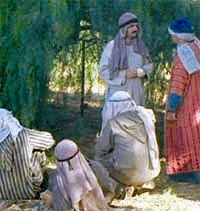
Jesus explained that Israel was the vineyard, hedged about and equipped with a winepress and a tower (see Isaiah 5:1-7). The householder in the parable rented his vineyard to tenants and then went away to a far country. At harvest time, he sent his servants to the tenants to receive his rent—a share of the fruit of the vineyard. But they beat one, killed another, and stoned yet another. The owner sent other servants, but the tenants treated them in the same manner. Then the owner sent his own son, thinking that the tenants would respect him.
"But when the tenants saw the son, they said to each other, 'This is the heir. Come, let's kill him and take his inheritance.' So they took him and threw him out of the vineyard and killed him" (Matthew 21:38, 39).
At this point in the parable, Jesus paused and asked:
 "
'Therefore, when the owner of the vineyard comes, what will he do to those
tenants?' 'He will bring those wretches to a wretched end,' they replied,
'and he will rent the vineyard to other tenants, who will give him his
share of the crop at harvest time' " (Matthew 21:40, 41).
"
'Therefore, when the owner of the vineyard comes, what will he do to those
tenants?' 'He will bring those wretches to a wretched end,' they replied,
'and he will rent the vineyard to other tenants, who will give him his
share of the crop at harvest time' " (Matthew 21:40, 41).
In answer, Jesus said:
"Have you never read in the Scriptures: 'The stone the builders rejected has become the capstone; the Lord has done this, and it is marvelous in our eyes?' Therefore I tell you that the kingdom of God will be taken away from you and given to a people who will produce its fruit" (Matthew 21:42, 43).
When they heard these words, "the chief priests and Pharisees . . . knew he was talking about them" (Matthew 21:45). They saw that the tenants in the parable—who had killed the owner's servants and his son—represented themselves. Israel's religious leaders had killed God's prophets and were even then planning the death of God's own Son. This revelation of their inmost thoughts and intents confused and angered them. But they did not repent. Rather, they "looked for a way to arrest him" (Matthew 21:46).
 Jesus
was "the stone the builders rejected," and He said that it "has
become the capstone" (Matthew 21:42). Israel might reject Christ,
but the leaders could not hinder the growth and final triumph of His kingdom.
Jesus said:
Jesus
was "the stone the builders rejected," and He said that it "has
become the capstone" (Matthew 21:42). Israel might reject Christ,
but the leaders could not hinder the growth and final triumph of His kingdom.
Jesus said:
"Therefore I tell you that the kingdom of God will be taken away from you and given to a people who will produce its fruit" (Matthew 21:43).
If Israel would not accept the light, the Gentiles would.
The story is told that on one occasion George Bjornson, the Norwegian poet, aroused the anger of the Norwegian parliament, so several members of that body made their way to his home, just outside old Christiana, and broke the windows. These angry men then marched away singing the national anthem, "Yes, We Love This Land of Ours!" But, as the story goes, Bjornson felt great satisfaction, for he was the author of that song. "They smashed his windows," said one observer, "but they had to sing his song!"
So it is with Jesus. His own people shunned Him as the Messiah, but let us pray that the time will come when many of them will turn to Him and, with the redeemed of all ages, sing the song of Christ and rejoice in His love.
THE
MAN WITHOUT A WEDDING GARMENT
(Read Matthew 22:1-14)
Christ next pressed home to the hearts of the people the claims of His
gospel. In the parable of the wedding garment He taught that personal
religious experience and faith are necessary. He showed how God has made
provision for everyone to avail themselves of heaven-born opportunity.
 Our
Lord described a certain king who made a marriage for his son and sent
out invitations. The servants went out to call the guests to the wedding,
but they would not come. They made light of the invitation and went their
respective ways—one to his farm, another to his merchandise. Finally,
the king's servants were taken and killed by those who had been invited
to the wedding. The angry king then sent his armies to destroy those murderers
and burn their city. He declared:
Our
Lord described a certain king who made a marriage for his son and sent
out invitations. The servants went out to call the guests to the wedding,
but they would not come. They made light of the invitation and went their
respective ways—one to his farm, another to his merchandise. Finally,
the king's servants were taken and killed by those who had been invited
to the wedding. The angry king then sent his armies to destroy those murderers
and burn their city. He declared:
"The wedding banquet is ready, but those I invited did not deserve to come. Go to the street corners and invite to the banquet anyone you find" (Matthew 22:8, 9).
So the servants went out and gathered in the rich and the poor, the good and the bad, "and the wedding hall was filled with guests" (Matthew 22:10).
In order to enter the banquet hall it was necessary for the guests to exchange the clothes they were wearing for a special wedding garment. When the king saw one man was dressed in street clothes, he said:
" 'Friend,' he asked, 'how did you get in here without wedding clothes?' The man was speechless. Then the king told the attendants, 'Tie him hand and foot, and throw him outside, into the darkness, where there will be weeping and gnashing of teeth.' For many are invited, but few are chosen" (Matthew 22:12-14).
 By
refusing to put on the wedding garment provided for those attending the
feast, this self righteous man insulted his sovereign. The feast had been
prepared at great cost. The wedding garment had been provided for him
at considerable expense, but he stubbornly refused this necessary preparation.
So he was cast "into the darkness" (Matthew 22:13).
By
refusing to put on the wedding garment provided for those attending the
feast, this self righteous man insulted his sovereign. The feast had been
prepared at great cost. The wedding garment had been provided for him
at considerable expense, but he stubbornly refused this necessary preparation.
So he was cast "into the darkness" (Matthew 22:13).
In the Bible, Christ's church is represented as the Lamb's wife, dressed in "fine linen, bright and clean" (Revelation 19:8), "without stain or wrinkle or any other blemish" (Ephesians 5:27). This clean, white garment is the righteousness of the saints that has been received by faith in Christ; it is His own unblemished character that God has given to those who fully receive Jesus into their hearts. Isaiah said, "All our righteous acts are like filthy rags" (Isaiah 64:6). "But now a righteousness from God, . . . comes through faith in Jesus Christ to all who believe" (Romans 3:21, 22).
This pure white robe of Christ's righteousness is our passport to heaven. Those who reach out by faith to obtain salvation through Christ will not be turned down, but will receive the wedding garment. Those who seek to enter, dressed in the garments of self righteousness, will be lost. This is what the nation of Israel attempted to do, and many today try to enter heaven in the same way.
WHAT
PROMISE OF FINAL REWARD DID CHRIST MAKE?
(Read Mark 10:17-31)
 The
experience of the rich young ruler offers a classic illustration of Israel's
leaders who turned away from the great Preacher of righteousness because
the truths He announced placed so much emphasis upon faith and sacrifice.
To them, the heavenly treasure counted less than their worldly possessions.
The
experience of the rich young ruler offers a classic illustration of Israel's
leaders who turned away from the great Preacher of righteousness because
the truths He announced placed so much emphasis upon faith and sacrifice.
To them, the heavenly treasure counted less than their worldly possessions.
This wealthy young man approached Christ with a sincere question. "Teacher, what good thing must I do to get eternal life?" (Matthew 19:16). He was eager to know how to make sure of heaven. Jesus' reply was simply stated. "If you want to enter life, obey the commandments" (Matthew 19:17). The Savior explained that in order for this young man to be acceptable to God, he must bring his life into harmony with the law that reveals God's character.
The young man probably thought that when Christ spoke of the commandments, He was referring to a ceremonial requirement, so he asked, "Which ones?" (Matthew 19:18). In reply, Jesus quoted from the Ten Commandments. He mentioned five of the commandments that deal with our relationship to our fellow men. These He summed up in the command, " 'Love your neighbor as yourself' " (Matthew 19:19). But Jesus did not cite the commandment against covetousness that struck at the young man's sin (see Exodus 20:17). The young ruler replied, "All these I have kept. . . . What do I still lack?" (Matthew 19:20). To this Jesus said, "If you want to be perfect, go, sell your possessions and give to the poor, and you will have treasure in heaven. Then come, follow me" (Matthew 19:21). The record is that, "When the young man heard this, he went away sad, because he had great wealth" (Matthew 19:22).
 As
the young man turned away, the Master said to His disciples, "How
hard it is to enter the kingdom of God!" (Mark 10:24; see also 1
Timothy 5:8; Malachi 3:8-10). The disciples were disillusioned at these
words. Like the religious leaders, they believed that the rich were favorites
in heaven, and they hoped that they themselves would be wealthy when the
kingdom of Christ was set up. If the wealthy were not entitled to heaven,
who were?
As
the young man turned away, the Master said to His disciples, "How
hard it is to enter the kingdom of God!" (Mark 10:24; see also 1
Timothy 5:8; Malachi 3:8-10). The disciples were disillusioned at these
words. Like the religious leaders, they believed that the rich were favorites
in heaven, and they hoped that they themselves would be wealthy when the
kingdom of Christ was set up. If the wealthy were not entitled to heaven,
who were?
Jesus replied:
"It is easier for a camel to go through the eye of a needle than for a rich man to enter the kingdom of God" (Mark 10:25, 26).
In amazement the disciples exclaimed:
" 'Who then can be saved?' Jesus looked at them and said, 'With man this is impossible, but not with God; all things are possible with God' " (Mark 10:26, 27).
A rich man may enter heaven, but his wealth gives him no title to heaven. The rich, as well as the poor, enter the realms of glory only through the unmerited mercy of Christ (see 1 Timothy 6:17-19). But Jesus did not disappoint His disciples. He explained that if they were faithful and trusted in His redeeming grace, they would receive great honors in the future life (see Matthew 19:28). Then He added significantly:
" 'I tell you the truth,' Jesus replied, 'no one who has left home or brothers or sisters or mother or father or children or fields for me and the gospel will fail to receive a hundred times as much in this present age (homes, brothers, sisters, mothers, children and fields—and with them, persecutions) and in the age to come, eternal life" (Mark 10:29, 30).
THE
PARABLE OF THE TEN VIRGINS
 (Read
Matthew 25:1-13)
(Read
Matthew 25:1-13)
In all His messages to Israel, Jesus presented the truth unflinchingly.
He clearly established the relationship between moral disaster and the
judgment of God. The dramatic story of the ten virgins was not given for
the benefit of the Jews only; it has a special message for Christians
today.
One day near the close of his ministry, while Christ was seated with His disciples on the Mount of Olives, He related this parable. It is altogether possible that a passing bridal procession suggested this thrilling story.
Near the bride's house were ten young women, each carrying a lighted lamp and a small flagon for oil. All were anxiously waiting and watching for the appearance of the bridegroom, but among them were two classes of watchers—the wise and the foolish.
There was a long delay. Finally at midnight, when all were sleeping, a loud cry rang out, "Here's the bridegroom! Come out to meet him!" (Matthew 25:6). The five wise virgins arose and trimmed their lamps. Fortunately, they had with them an extra supply of oil. They joined the bridal party and marched along to the wedding with their lamps burning. But the foolish virgins had no extra oil, and their lamps went out. They pled with the wise virgins to share their oil with them, but they dared not—in case they did not have enough for themselves. They replied, "Go to those who sell oil and buy some for yourselves" (Matthew 25:9).
So, while the foolish virgins were out trying to find oil for their lamps, the five wise virgins joined the bridal party and moved on to the home of the bridegroom. Later the foolish virgins arrived and sought entrance, but it was too late. The door was shut, and they were left out in the cold, dark night.
 This
parable describes the experience of God's people who are watching and
waiting for their Lord's return. The lamps in the hands of the virgins
represent the Word of God, and the oil stands for the Holy Spirit. The
five wise virgins represent those who have the Word of God in their hearts.
Most importantly, they have the oil of the Holy Spirit to make their lives
a light for God. They are ready when Christ, the Bridegroom, appears to
take His church to the marriage supper in heaven (see Revelation 19:6-9).
But, just as the five foolish virgins were refused entrance to the feast
because their lights had gone out, so those who have only a form of religion,
without spiritual power, will never enter heaven. Christ and His Spirit
have left them, and they walk in darkness.
This
parable describes the experience of God's people who are watching and
waiting for their Lord's return. The lamps in the hands of the virgins
represent the Word of God, and the oil stands for the Holy Spirit. The
five wise virgins represent those who have the Word of God in their hearts.
Most importantly, they have the oil of the Holy Spirit to make their lives
a light for God. They are ready when Christ, the Bridegroom, appears to
take His church to the marriage supper in heaven (see Revelation 19:6-9).
But, just as the five foolish virgins were refused entrance to the feast
because their lights had gone out, so those who have only a form of religion,
without spiritual power, will never enter heaven. Christ and His Spirit
have left them, and they walk in darkness.
The bridegroom came at midnight, the darkest hour. So the coming of our Savior will take place at the darkest hour in human history. That time is near, and for those who are wise and watch for their Lord, it will be a day of great rejoicing.
In the days of our Lord, many acted foolishly and let their lights go out. Christ came as a preacher of righteousness to light their lamps again, but they spurned the light from heaven. So they were lost in the darkest midnight, for they had neglected their opportunity. Let's learn a lesson from their experience and watch for the Bridegroom with our lamps trimmed and burning, waiting for our Lord's return.
We
know not the hour when he cometh,
At even, or midnight, or morn;
It may be at deepening twilight,
It may be at earliest dawn.
He
bids us to watch and be ready,
Nor suffer our lights to grow dim.
That when he shall come, He may find us
All watching and waiting for Him.

**********************************************************************
Original
manuscript author: Beatrice S. Neall
Editors revised edition: Barbara Shelley, Sue Robinson
Design and Layout: DEC Designs, Morisset, New South Wales Australia.
Used by permission of Discovery Centre, Wahroonga, New South Wales, Australia.
Graphics: Still images taken from Matthew video, copyright © 1997,
2004 by International Bible Society. Used by permission of International
Bible Society.
Scripture: Scripture taken from the HOLY BIBLE, NEW INTERNATIONAL VERSION
®. Copyright © 1973, 1978, 1984 by International Bible Society.
Cover Picture: "The Light of the World" by Nathan Green, ©2004
All Rights Reserved.
www.hartclassics.com
Copyright © 2007
revised edition, Voice of Prophecy, California.