Light of the World
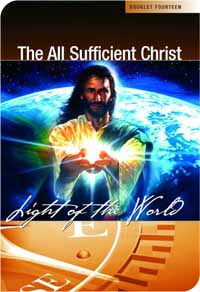
Booklet 14
The
All Sufficient Christ
"For to us a child is born, to us a son is given, and the government will be on his shoulders. And he will be called Wonderful Counselor, Mighty God, Everlasting Father, Prince of Peace" (Isaiah 9:6).
The name Jesus means "Savior" (see Matthew 1:21, margin). This was the name given to Christ by the angel before He was born. The disciples addressed Jesus simply as "Master." This term of respect is the same as "Rabbi" or "Teacher." They also called him "Lord." By the unbeliever who doubted His claims, He was referred to as "Jesus, the son of Joseph." Those who were convinced of His divine nature alluded to him as "Christ" or "Messiah." In this booklet, we will consider the many names and offices of Christ.
 There
are many names in the Old and New Testament that refer to Christ, suggesting
the all-sufficiency of the Lord Jesus (see Isaiah 9:6) as well as His
character and work as humanity's Savior. Jesus speaks to men and women
of all races and temperaments by His many-sided appeals. A careful thinker
has put it this way:
There
are many names in the Old and New Testament that refer to Christ, suggesting
the all-sufficiency of the Lord Jesus (see Isaiah 9:6) as well as His
character and work as humanity's Savior. Jesus speaks to men and women
of all races and temperaments by His many-sided appeals. A careful thinker
has put it this way:
To the artist, He is the One altogether lovely. To the architect, He is the Chief Corner Stone. To the astronomer, He is the Sun of Righteousness. To the baker, He is the Living Bread. To the banker, He is the Hidden Treasure. To the biologist, He is the Life. To the builder, He is the Sure Foundation. To the Carpenter, He is the Door. To the doctor, He is the Great Physician. To the educator, He is the Great Teacher. To the engineer, He is the New and Living Way. To the farmer, He is the Sower and the Lord of the Harvest. To the florist, He is the Rose of Sharon and the Lily of the Valley. To the geologist, He is the Rock of Ages. To the horticulturist, He is the True Vine.
To the judge, He is the Righteous Judge, the Judge of all men. To the juror, He is the Faithful and True Witness. To the jeweler, He is the Pearl of Great Price. To the lawyer, He is the Counselor, the Lawgiver, the Advocate. To the newspaper man, He is the Good Tidings of Great Joy. To the oculist, He is the Light of the Eyes. To the philanthropist, He is the Unspeakable Gift. To the philosopher, He is the Wisdom of God. To the preacher, He is the Word of God. To the sculptor, He is the Living Stone. To the servant, He is the Good Master. To the statesman, He is the Desire of All Nations. To the student, He is the Incarnate Truth. To the theologian, He is the Author and Finisher of our faith. To the toiler, He is the Giver of Rest. To the sinner, He is the Lamb of God that takes away the sins of the world. To the Christian, He is the Son of the Living God, the Savior, the Redeemer, and Lord.—Selected.
In this booklet, we will observe how completely adequate is Jesus' power and authority. His right to the position of Elder Brother, Savior, and Lord of mankind is absolutely unchallenged, as we will discover.
HOW
CLOSE IS THE RELATIONSHIP BETWEEN CHRIST AND HUMANITY?
Christ is Elder Brother to all of us, to the members of all races and
tribes. It is encouraging to know that we have an Elder Brother who is
not only God's Son but also the Son of man. He stands at the head of the
human family to protect and to keep his own.
 "For
surely it is not angels he helps, but Abraham's descendants. For this
reason he had to be made like his brothers in every way, in order that
he might become a merciful and faithful high priest" (Hebrews
2:16, 17).
"For
surely it is not angels he helps, but Abraham's descendants. For this
reason he had to be made like his brothers in every way, in order that
he might become a merciful and faithful high priest" (Hebrews
2:16, 17).
Jesus' example and teachings throughout the three-and-a-half years of His public ministry emphasized the fact that not only the Jews (see Matthew 10:5, 6) but also the Samaritans (see John 4:40, 41), the Greeks (see John 12:20-23), the Romans (see Luke 23:47), and all nations of the earth (see Matthew 28:18-20) may share in this close relationship with Him.
The brotherhood of man, with Christ as Elder Brother, and the fatherhood of God, with God himself as reigning Lord, are the great objectives that Jesus sought to bring about through His ministry. Christ, the Son of God, taught us all to pray, "Our Father in heaven" (Matthew 6:9).
God is the Father of all people everywhere, in all ages and at all times. Those who receive Christ as their Savior and Lord enter the kingdom of heaven as the adopted children of the heavenly Father (see Romans 8:14-17). And since this privilege extends to individuals of all races, how respectfully we ought to regard those of nations and languages different from our own!
WHAT
DID CHRIST DECLARE HIMSELF TO BE?
 Christ
taught the brotherhood of man—not only by precept but by example.
But His ministry to non-Jews was offensive to the Israelites, who were
proud of being the children of Abraham and the favorite sons of God. They
were offended by the willingness of the Messiah to share the blessings
of salvation equally with all people. So Jesus often came into conflict
with the Jewish leaders over this matter. He had come not only as the
Light of Israel, but the Light of the world. John said:
Christ
taught the brotherhood of man—not only by precept but by example.
But His ministry to non-Jews was offensive to the Israelites, who were
proud of being the children of Abraham and the favorite sons of God. They
were offended by the willingness of the Messiah to share the blessings
of salvation equally with all people. So Jesus often came into conflict
with the Jewish leaders over this matter. He had come not only as the
Light of Israel, but the Light of the world. John said:
"The true light that gives light to every man was coming into the world" (John 1:9).
In the temple at Jerusalem, Christ enunciated this great truth:
"I am the light of the world. Whoever follows me will never walk in darkness, but will have the light of life" (John 8:12).
In these words, "I am the light of the world," Jesus declared Himself to be the Messiah. In this same temple where Christ was teaching, the aged Simeon had spoken of him as "a light for revelation to the Gentiles and for glory to your people Israel" (Luke 2:32). In these words, Simeon was applying to Jesus a prophecy familiar to all Israel. The prophet Isaiah had declared, "It is too small a thing for you to be my servant to restore the tribes of Jacob and bring back those of Israel I have kept. I will also make you a light for the Gentiles, that you may bring my salvation to the ends of the earth" (Isaiah 49:6). This prophecy was generally understood to be referring to the Messiah, and when Jesus said, "I am the light of the world," the people could not fail to recognize His claim to be the Promised One.
The light of truth that shone from Jesus' life and teachings transcends all other light. Someone has remarked that Socrates taught for forty years, Plato for fifty, Aristotle for forty, and Jesus for only three—yet the three years that Christ taught infinitely exceeded in influence the combined 130 years of Plato, Socrates, and Aristotle—three of the greatest philosophers of all time.
The grandest paintings of Raphael, Michelangelo and Leonardo da Vinci are but a reflection of Jesus, the Light of the world. Haydn, Handel, Bach, and Mendelssohn gave to the world their best melodies in the symphonies and oratorios they wrote to glorify Jesus Christ. Art, culture, music, philosophy—all have been enriched by His teachings. But Christ offers far more than philosophy, art, and music. These cannot save. Jesus offers light and life and salvation to sinful men and women. And if you will let His light shine in your life, you will find the way to peace and security.
WHAT
TITLE DID CHRIST CLAIM?
In discussing with the Jewish authorities the question of His divine origin,
the Savior declared openly and with deep solemnity:
 "
'I tell you the truth,' Jesus answered, 'before Abraham was born, I am!'
" (John 8:58; see also Exodus 3:13-15).
"
'I tell you the truth,' Jesus answered, 'before Abraham was born, I am!'
" (John 8:58; see also Exodus 3:13-15).
By this Jesus meant that He lived before Abraham (see Booklet 3). "I am" is the name by which God identified Himself to Moses in order to express the idea of His eternal presence. When Jesus claimed that title for Himself, the rabbis were infuriated and cried out against Him as a blasphemer.
"At this, they picked up stones to stone him, but Jesus hid himself, slipping away from the temple grounds" (John 8:59).
A few months later, they said to Him plainly:
" 'We are not stoning you for any of these,' replied the Jews, 'but for blasphemy, because you, a mere man, claim to be God' " (John 10:33).
But the opposition of stubborn hearts could not destroy the truthfulness of Jesus' declaration. The Son of man, our Elder Brother, was also the divine Son of God who has lived forever. Christ did not say "I was" or "I will be," but "I am." He lives today (see Hebrews 13:8).
If you desire spiritual guidance, He says, "I am the good shepherd" (John 10:11). If you desire food for your soul, He says, "I am the living bread" (John 6:51). If you desire to know the way of salvation, He says, "I am the way and the truth and the life" (John 14:6). If you want power, He declares, "All authority in heaven and on earth has been given to me" (Matthew 28:18). Jesus says, "I am the One whom you may trust now, today. Don't be afraid." Yes, Christ is the embodiment of all that human beings expect of divinity. No one who trusts Him as Lord and Savior will ever be disappointed. Go to Him in prayer, and He will provide the answer to every material and spiritual problem.
CHRIST
OUR RIGHTEOUSNESS
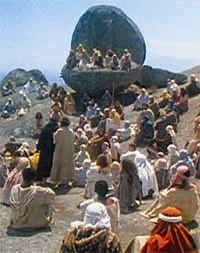
In His sermon on the mount, Christ declared to the people in the presence
of the rabbis:
 "For
I tell you that unless your righteousness surpasses that of the Pharisees
and the teachers of the law, you will certainly not enter the kingdom
of heaven" (Matthew 5:20).
"For
I tell you that unless your righteousness surpasses that of the Pharisees
and the teachers of the law, you will certainly not enter the kingdom
of heaven" (Matthew 5:20).
Pharisaical righteousness consisted of a theoretical knowledge of religion and the meticulous performance of the external forms and ceremonies of worship. The Pharisees thought that the gates of heaven would open widest to those who made the greatest profession of religion and who exerted themselves most strenuously in keeping the smallest requirements of the law.
Christ made it plain that this was not true righteousness, but self righteousness. The righteousness that saves is Christ's righteousness. He explained that the only kind of righteousness that is acceptable to God is that which comes from God. Right doing from right motives is a consequence of a right relationship between an individual and his or her Savior. A mere profession of religion is not enough. Neither is the strict observance of the requirements of religion. The life must be changed. Sincerity, kindness, patience, forbearance, joy, peace, and love must appear, and all of these virtues come from Christ.
Concerning the Savior, Jeremiah declared that:
"This is the name by which he will be called: The LORD Our Righteousness" (Jeremiah 23:6).
 The
only way that sinful human beings can become righteous—and remain
righteous—is to possess faith in Christ. The stony heart must be
changed. God must give us a tender heart, a heart of flesh.
The
only way that sinful human beings can become righteous—and remain
righteous—is to possess faith in Christ. The stony heart must be
changed. God must give us a tender heart, a heart of flesh.
In His early ministry in Judea, Christ said to Nicodemus, "You must be born again" (John 3:7; see also Ezekiel 36:26, 27). This message to the proud Pharisee might have been spoken with equal force to all the rabbis of Israel and to all the people. And its message still applies today.
The ordinances of the gospel—which will be discussed in Booklet 22—are a curse, even to Christians, unless they are interpreted to express faith in God and the plan of salvation. And good works are not adequate as a means of salvation. We are saved neither by our profession nor by our works. We are saved by Christ. When He is in the heart as a living presence, righteousness and good works will appear as the fruit of His grace. This is what is meant by having a righteousness that exceeds the righteousness of the scribes and Pharisees. Christ taught that this experience is essential for all who would be subjects of His kingdom. It is faith that makes Christ's righteousness a part of us (see Romans 3:19-26).
JESUS,
THE SOURCE OF ALL SPIRITUAL POWER
The means by which Christians are to become strong in righteousness is
Christ Himself. He said:
 "I
am the bread of life. He who comes to me will never go hungry, and he
who believes in me will never be thirsty" (John 6:35).
"I
am the bread of life. He who comes to me will never go hungry, and he
who believes in me will never be thirsty" (John 6:35).
Christ spoke these words on the day following His feeding of the five thousand on the shores of the Lake of Galilee, when the people came again seeking him (see John 6:24). The crowd gathered about the Savior, and on this occasion He uttered the deepest spiritual truths of His ministry. Fearful that the people had come just for the loaves and fishes, Jesus said:
"I tell you the truth, you are looking for me . . . because you ate the loaves and had your fill. Do not work for food that spoils, but for food that endures to eternal life, which the Son of Man will give you. On him God the Father has placed his seal of approval" (John 6:26, 27).
This "food that endures," He declared, "is my flesh, which I will give for the life of the world" (John 6:51).
"Whoever eats my flesh and drinks my blood has eternal life. . . . For my flesh is real food and my blood is real drink" John 6:54, 55).
Here Christ is explaining the secret of the spiritual life. We must not interpret these words to mean that Christ Himself is literally present in our daily bread or in the communion bread. He makes His meaning clear in the following statement:
"The Spirit gives life; the flesh counts for nothing. The words I have spoken to you are spirit and they are life" (John 6:63).
 It
is Christ and His Word that give life. What food is to the body,
Christ is to the soul. We receive no benefit from bread unless we eat
it and it becomes a part of us. And we receive no help from Christ unless
we know Him as our personal Savior. Theoretical knowledge alone will do
no one any good. As the physical life is sustained by food, so the spiritual
life is sustained by Christ and His Word.
It
is Christ and His Word that give life. What food is to the body,
Christ is to the soul. We receive no benefit from bread unless we eat
it and it becomes a part of us. And we receive no help from Christ unless
we know Him as our personal Savior. Theoretical knowledge alone will do
no one any good. As the physical life is sustained by food, so the spiritual
life is sustained by Christ and His Word.
But the Jews misinterpreted Christ's words concerning the bread of life, just as many Christians do today. "How can this man give us his flesh to eat?" they questioned (John 6:52). They were offended, and many who professed to be His disciples said, "This is a hard teaching. Who can accept it?" (John 6:60). So they forsook Jesus and followed Him no more. But Peter and the eleven were unshaken. They affirmed, "We believe and know that you are the Holy One of God" (John 6:69). This experience brought on a severe crisis in Christ's work. Soon afterward, He withdrew from Capernaum, crossed Galilee, and made His way to the hill country of Phoenicia.
UPON
WHAT FOUNDATION DID CHRIST BUILD HIS CHURCH?
Jesus is the rock upon which the true church is built. He, the Righteous
One, and no mere human, is the foundation stone of the kingdom. Hundreds
of years before the Savior's birth in Bethlehem, Moses had pointed to
"the Rock" of Israel's salvation (Deuteronomy 32:4). The psalmist
had sung of "my mighty rock, my refuge" (Psalm 62:7). Isaiah
had written:
 "So
this is what the Sovereign LORD says, 'See, I lay a stone in Zion, a tested
stone, a precious cornerstone for a sure foundation" (Isaiah
28:16).
"So
this is what the Sovereign LORD says, 'See, I lay a stone in Zion, a tested
stone, a precious cornerstone for a sure foundation" (Isaiah
28:16).
Christ's disciples recognized this. After the crisis in Galilee, He sent the disciples on a missionary tour. Upon their return, Jesus asked them pointedly:
" 'Who do people say the Son of Man is?' They replied, 'Some say John the Baptist; others say Elijah; and still others, Jeremiah or one of the prophets.' 'But what about you?' he asked. 'Who do you say I am?' Simon Peter answered, 'You are the Christ, the Son of the living God.' Jesus replied, 'Blessed are you, Simon son of Jonah, for this was not revealed to you by man, but by my Father in heaven. And I tell you that you are Peter, and on this rock I will build my church, and the gates of Hades will not overcome it. I will give you the keys of the kingdom of heaven; whatever you bind on earth will be bound in heaven, and whatever you loose on earth will be loosed in heaven' " (Matthew 16:13-19).
When Christ spoke about "this Rock," He referred to Himself, the One whom Peter confessed to be "the Son of the living God." Jesus Himself is the Rock upon which the church is built. The gates of hell cannot prevail against the church, but the gates of hell did prevail against Peter when he was overcome with temptation and denied his Lord with cursing and swearing (see Matthew 26:69-75). Peter himself referred to Christ as the foundation of the church, upon which the "spiritual house" was built. He said:
 "Now
that you have tasted that the Lord is good. As you come to him, the living
Stone—rejected by men but chosen by God and precious to him—you
also, like living stones, are being built into a spiritual house"
(1 Peter 2:3-5).
"Now
that you have tasted that the Lord is good. As you come to him, the living
Stone—rejected by men but chosen by God and precious to him—you
also, like living stones, are being built into a spiritual house"
(1 Peter 2:3-5).
Paul said:
"For no one can lay any foundation other than the one already laid, which is Jesus Christ" (1 Corinthians 3:11).
"On this rock," said Jesus, "I will build my church" (Matthew 16:18). If Christ had made Peter the rock upon which His church was founded, the apostles would not have been contending among themselves as to who should be the greatest (see Luke 22:24). They would have been willing to recognize the desire of their Master and honor the one whom He had chosen to be their leader.
Christ did not appoint one of the twelve apostles to a position of pre-eminence, but He did say to them:
"But you are not to be called 'Rabbi,' for you have only one Master and you are all brothers. . . . Nor are you to be called 'teacher,' for you have one Teacher, the Christ" (Matthew 23:8, 10).
The disciples called Jesus "Master," but they did not call Peter "master." The Savior gave the same authority and power to the other disciples that He did to Peter (see Matthew 18:1, 15-18). But Christ alone was the foundation and leader, "the head of the church" (Ephesians 5:23).
WHAT
TITLE DID A PAGAN RULER GIVE TO JESUS?
Not many of the Jews recognized Jesus as the leader of the kingdom. The
Scripture says:
"He came to that which was his own, but his own did not receive him" (John 1:11).
 Finally
His own countrymen brought Him to Pilate, the Roman governor, and accused
Him of sedition. But while the Jewish leaders rejected Christ as the Messiah,
Pilate, pagan that he was, recognized that there stood before him One
who was more than a man. Conscience smitten, he exclaimed, "You are
a king, then!" (John 18:37). Jesus replied:
Finally
His own countrymen brought Him to Pilate, the Roman governor, and accused
Him of sedition. But while the Jewish leaders rejected Christ as the Messiah,
Pilate, pagan that he was, recognized that there stood before him One
who was more than a man. Conscience smitten, he exclaimed, "You are
a king, then!" (John 18:37). Jesus replied:
"You are right in saying I am a king. In fact, for this reason I was born, and for this I came into the world, to testify to the truth. Everyone on the side of truth listens to me" (John 18:37).
Convinced, Pilate immediately tried to find a way to release Christ. He said to the Jews:
"Do you want me to release 'the king of the Jews'?" (John 18:39).
But they demanded His death, and Pilate consented to His execution much against his better judgment. Pilate was a weak character, willing that Christ should be crucified in order that he might retain the favor of the Jewish leaders. But on Christ's cross Pilate caused to be inscribed the words: "JESUS OF NAZARETH, THE KING OF THE JEWS" (John 19:19).
The Jewish leaders objected to this and requested Pilate to change the inscription to read, "this man claimed to be king of the Jews" (John 19:21). Pilate answered, "What I have written, I have written" (John 19:22). This was providential, for Jesus was, indeed, the King of Israel.
Christ will yet be acknowledged and honored by the Israel of God as their King, but not by Israel as a nation. The Israel of God today is a spiritual nation made up of men and women of all races (see 1 Peter 2:9).
An individual is not a Jew if he or she is one only outwardly, nor is circumcision merely outward and physical. No, a person is a Jew if he or she is one inwardly, and circumcision is circumcision of the heart, by the Spirit (see Romans 2:28, 29).
 In
the coming kingdom of glory, Christ will reign over all the earth, not
just over the Jews. He will be the King of the ransomed throng who are
redeemed from every tribe and nation of the earth. When Jesus returns
we shall see "on his robe and on his thigh . . . this name written:
KING OF KINGS AND LORD OF LORDS" (Revelation 19:16). Then, those
who have rejected Him will cry to the mountains and rocks:
In
the coming kingdom of glory, Christ will reign over all the earth, not
just over the Jews. He will be the King of the ransomed throng who are
redeemed from every tribe and nation of the earth. When Jesus returns
we shall see "on his robe and on his thigh . . . this name written:
KING OF KINGS AND LORD OF LORDS" (Revelation 19:16). Then, those
who have rejected Him will cry to the mountains and rocks:
"Fall on us and hide us from the face of him who sits on the throne and from the wrath of the Lamb! For the great day of their wrath has come, and who can stand?" (Revelation 6:16, 17).
But there will be found among all the nations and races of earth a faithful company of believers, the true Israel of God, who will be waiting and watching for Jesus' appearing. To these He will say:
"Come, you who are blessed by my Father; take your inheritance, the kingdom prepared for you since the creation of the world" (Matthew 25:34).
How important it is that we will be among those who are looking for His appearing! (see Titus 2:13). The secret of being prepared for that great event is to know Him, of whom Peter said:
"Salvation is found in no one else, for there is no other name under heaven given to men by which we must be saved" (Acts 4:12).

**********************************************************************
Original
manuscript author: Beatrice S. Neall
Editors revised edition: Barbara Shelley, Sue Robinson
Design and Layout: DEC Designs, Morisset, New South Wales Australia.
Used by permission of Discovery Centre, Wahroonga, New South Wales, Australia.
Graphics: Still images taken from Matthew video, copyright © 1997,
2004 by International Bible Society. Used by permission of International
Bible Society.
Scripture: Scripture taken from the HOLY BIBLE, NEW INTERNATIONAL VERSION
®. Copyright © 1973, 1978, 1984 by International Bible Society.
Cover Picture: "The Light of the World" by Nathan Green, ©2004
All Rights Reserved.
www.hartclassics.com
Copyright © 2007
revised edition, Voice of Prophecy, California.