Light of the World
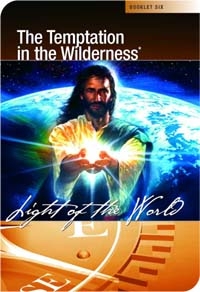
Booklet 6
The
Temptation in the Wilderness*
"Jesus, full of the Holy Spirit, returned from the Jordan and was led by the Spirit in the desert, where for forty days he was tempted by the devil. He ate nothing during those days" (Luke 4:1, 2).
 Today
we will take an unusual journey. We will follow the footsteps of Jesus
into the wilderness of temptation, a wild and desolate country rising
westward from the valley through which the Jordan River flows. Tradition
points to a mountain about six miles northwest of Jericho as the scene
of His temptation. It is called Mt. Quarantania in allusion to His forty-day
fast.
Today
we will take an unusual journey. We will follow the footsteps of Jesus
into the wilderness of temptation, a wild and desolate country rising
westward from the valley through which the Jordan River flows. Tradition
points to a mountain about six miles northwest of Jericho as the scene
of His temptation. It is called Mt. Quarantania in allusion to His forty-day
fast.
This forsaken country, known as the Wilderness of Judea, was probably uninhabited in the time of Jesus except for wild beasts. In this hilly land of stone and sand, Christ endured a period of great temptation. John A. Broadus, a great Bible student and teacher, says, "Familiar as we are with the simple narrative, it presents one of the most wonderful, mysterious, and awful scenes of the world's history."
Jesus had no contact with any human being during His forty-day fast. He was alone in the wilderness except for the presence of Satan, who tormented him, and angels who strengthened him to endure. Alone, Jesus became the conqueror over Satan and sin, and His wilderness conflict and victory are heaven's assurance of our own victory over evil.
"Because he himself suffered when he was tempted, he is able to help those who are being tempted" (Hebrews 2:18).
The best protection against temptation is faith in Christ. His victory over temptation is our pledge of triumph in the battle with sin. Those who are struggling with temptation will find wonderful help by reading the first chapter of James. Now, let's follow Jesus into the wilderness experience.
WHO
LED CHRIST INTO THE WILDERNESS?
"Then Jesus was led by the Spirit into the desert to be tempted
by the devil. After fasting forty days and forty nights, he was hungry"
(Matthew 4:1, 2).
 Jesus
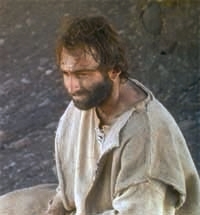
did not go deliberately and of His own accord into the wilderness to be
tempted. He was providentially led there so that He could be alone to
think about His work and pray over His future plans. By fasting and prayer,
he sought to prepare Himself to travel the hard road that lay ahead. When
Satan saw that Christ was alone in the wilderness, he took advantage of
the opportunity to tempt Him.
Jesus
did not go deliberately and of His own accord into the wilderness to be
tempted. He was providentially led there so that He could be alone to
think about His work and pray over His future plans. By fasting and prayer,
he sought to prepare Himself to travel the hard road that lay ahead. When
Satan saw that Christ was alone in the wilderness, he took advantage of
the opportunity to tempt Him.
During this period of nearly six weeks, Jesus engaged in the most terrible conflict of His life—with the exception of His struggle in the Garden of Gethsemane a little more than three years later. Even Moses and Elijah, both of whom fasted forty days, did not pass through so trying an experience.
Think of the suffering that Christ endured. First, He was alone with the wild beasts and the poisonous snakes of the desert hills. Second, He was without food of any kind for forty long days. Third, He was approached personally by the devil, who presented to Him the most cunning temptations at a time when He was weak and suffering from extreme hunger.
WHAT
WAS THE FIRST TEMPTATION?
When Satan came to Christ with the first of three great temptations, he
suggested that Jesus satisfy His appetite. He challenged Jesus to prove
that He was the Son of God by changing the desert stones into bread and
appeasing His hunger.
"The tempter came to him and said, 'If you are the Son of God, tell these stones to become bread.' Jesus answered, 'It is written: "Man does not live on bread alone, but on every word that comes from the mouth of God" ' " (Matthew 4:3, 4).
The tempter probably appeared as a messenger of light in order to deceive Christ (see 2 Corinthians 11:14, 15). Jesus was emaciated and weakened from His long fast. Body, mind, and spirit had been tested to the limit. Taking unfair advantage of this situation, Satan came suddenly upon Christ, tempting Him first to doubt His divine Sonship, and then to satisfy His appetite.
 "The
first Adam," said Dwight L. Moody, "was tempted in the garden,
and fell; the second Adam in the wilderness, and he came off victorious."
Appetite was the basis of Adam's temptation in the Garden of Eden, and
it was also the basis for Christ's temptation in the Judean wilderness.
As one writer has said: "Just where the ruin began, the work of our
redemption must begin. As by the indulgence of appetite Adam fell, so
by the denial of appetite Christ must overcome."
"The
first Adam," said Dwight L. Moody, "was tempted in the garden,
and fell; the second Adam in the wilderness, and he came off victorious."
Appetite was the basis of Adam's temptation in the Garden of Eden, and
it was also the basis for Christ's temptation in the Judean wilderness.
As one writer has said: "Just where the ruin began, the work of our
redemption must begin. As by the indulgence of appetite Adam fell, so
by the denial of appetite Christ must overcome."
For thousands of years the descendants of Adam had indulged appetite and passion until they had no power to resist the temptation to intemperance and impurity. In order to save mankind from the slavery of fleshly lust, Christ, "the last Adam" (1 Corinthians 15:45), endured nearly six weeks of starvation. In our behalf, He exercised a self control so strong that all the power of Satan could not break His will.
In order to understand the conflict that Christ endured, let's get a picture of the powerful adversary who tempted Him. It was Satan, a real being, a fallen angel who was cast out of heaven (see Revelation 12:7-9). Jesus Himself said concerning him, "I saw Satan fall like lightning from heaven" (Luke 10:18). He was created a beautiful sinless angel—Lucifer, Son of the Morning—not a monster with hoofs and horns. God did not make a devil. Lucifer made himself a devil when he chose to indulge pride and vanity. Of him the Lord said:
"You were the model of perfection, full of wisdom and perfect in beauty" (Ezekiel 28:12).
Lucifer had stood in the light of God's presence and knew much of His plans for His vast universe. The prophet Ezekiel said:
"You were blameless in your ways from the day you were created till wickedness was found in you" (Ezekiel 28:15).
 Original
sin was found in Lucifer, not God. He had said, "I will ascend above
the tops of the clouds; I will make myself like the Most High" (Isaiah
14:14). This envy led to open rebellion. God saw fit to remove this sore
spot from heaven, so Lucifer and his followers—about one-third of
the angels (see Revelation 12:3, 4)—were cast out of heaven into
this world. It was this powerful being who tempted Christ in the wilderness.
Original
sin was found in Lucifer, not God. He had said, "I will ascend above
the tops of the clouds; I will make myself like the Most High" (Isaiah
14:14). This envy led to open rebellion. God saw fit to remove this sore
spot from heaven, so Lucifer and his followers—about one-third of
the angels (see Revelation 12:3, 4)—were cast out of heaven into
this world. It was this powerful being who tempted Christ in the wilderness.
Coming to Christ, Satan suggested that He turn the desert stones into bread to satisfy His hunger. The enemy revealed his perverse character by his insinuation of distrust—"If you are the Son of God," he said. Jesus refused to doubt that He was God's Son. Fresh in the Savior's memory were the words of His heavenly Father, spoken at His recent baptism—"This is my Son, whom I love; with him I am well pleased" (Matthew 3:17). So Jesus did not weaken. He refused to doubt God or to exercise His divine power to provide bread for Himself. Jesus met the temptation by quoting the Scripture:
"It is written: 'Man does not live on bread alone, but on every word that comes from the mouth of God' " (Matthew 4: 4).
That was all that was necessary. Satan had no power against the "sword of the Spirit, which is the word of God" "living and active. Sharper than any double-edged sword" (Ephesians 6:17; Hebrews 4:12). The adversary was unsuccessful in this first temptation.
 In
your struggle against temptation and material attractions, remember that
with God's help, spiritual things become stronger than earthly attractions.
The power of the Word of God is yours for victory if you will but read
it and hold fast to its promises. It is impossible for us, in our own
strength, to resist the temptation to indulge in bad habits. But "looking
unto Jesus" (Hebrews 12:2, NKJV), our feet will be directed into
habits of righteousness, and we will overcome.
In
your struggle against temptation and material attractions, remember that
with God's help, spiritual things become stronger than earthly attractions.
The power of the Word of God is yours for victory if you will but read
it and hold fast to its promises. It is impossible for us, in our own
strength, to resist the temptation to indulge in bad habits. But "looking
unto Jesus" (Hebrews 12:2, NKJV), our feet will be directed into
habits of righteousness, and we will overcome.
A company of young soldiers was once drilling on the main street of a small town. The leader gave orders with short, crisp commands, but the young recruits stumbled all over themselves. With a note of irritation the sergeant barked out, "Quit looking down at your feet! Eyes to the front! Your feet will follow your eyes!"
If we will but look up and fasten our eyes on Jesus, our feet will walk in the way of righteousness, and we will find ourselves being drawn toward Him. "But take heart!" he says to the struggling soul, "I have overcome the world" (John 16:33).
HOW
DID SATAN NEXT TEMPT CHRIST?
Satan's next assault upon Christ was a bold and presumptuous act. Placing
him upon the pinnacle of the temple, he suggested that Christ prove His
divine Sonship by throwing Himself down to the ground without killing
Himself.
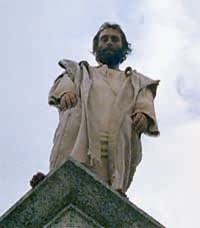 "Then
the devil took him to the holy city and had him stand on the highest point
of the temple. 'If you are the Son of God,' he said, 'throw yourself down.
For it is written: "He will command his angels concerning you, and
they will lift you up in their hands, so that you will not strike your
foot against a stone." Jesus answered him, 'It is also written: "Do
not put the Lord your God to the test" ' " (Matthew 4:5-7).
"Then
the devil took him to the holy city and had him stand on the highest point
of the temple. 'If you are the Son of God,' he said, 'throw yourself down.
For it is written: "He will command his angels concerning you, and
they will lift you up in their hands, so that you will not strike your
foot against a stone." Jesus answered him, 'It is also written: "Do
not put the Lord your God to the test" ' " (Matthew 4:5-7).
Satan doubtless would like to have hurled Christ to His death on the pavement below, but he did not have the power to do that. So he commanded Jesus to jump of His own volition.
In this temptation, Satan urged Jesus to commit the sin of presumption. To "presume," from which the word presumption comes, means "to take upon oneself without leave, authority, or warrant; to undertake in rash defiance, in over confidence, or in vain hope."
 Satan
assured Christ that, according to the Scriptures (see Psalm 91:11, 12),
the angels would hold Him up in their arms lest He kill Himself in the
fall. "Prove that You are the Son of God," Satan commanded.
"If You are God's Son, the angels will come and protect You."
Satan
assured Christ that, according to the Scriptures (see Psalm 91:11, 12),
the angels would hold Him up in their arms lest He kill Himself in the
fall. "Prove that You are the Son of God," Satan commanded.
"If You are God's Son, the angels will come and protect You."
The devil is clever at quoting Scripture, but in this case he failed to quote it in its proper context. Jesus knew that this promise refers only to those who walk in God's ways. The Savior would not have been walking in God's ways had He shown such foolhardiness and presumption. Nothing could be gained by such an exhibition of vanity. Turning upon Satan, He declared:
"It is also written: 'Do not put the Lord your God to the test' " (Matthew 4:7).
At the baptism of Jesus, God had already testified that Jesus was His Son. Now, the devil wanted to put God's word to the test. He was tempting God, putting God on trial.
Jesus refused to comply with Satan's demand. Resting in the knowledge of His Father's love, He rebuked the devil and taught, by His example, that we may safely trust the Scriptures.
WHAT
WAS THE FINAL TEMPTATION?
The third and final inducement to sin that the devil held before the Savior
is described in these words:
"Again, the devil took him to a very high mountain and showed him all the kingdoms of the world and their splendor. 'All this I will give you,' he said, 'if you will bow down and worship me.' Jesus said to him, 'Away from me, Satan! For it is written: "Worship the Lord your God, and serve him only" ' " (Matthew 4:8-10).
 The
scene now changes from the pinnacle of the temple in Jerusalem to the
summit of an unknown mountain. In this final temptation, the character
of the tempter is fully revealed. With all pretence laid aside, he offers
Christ the supremacy of the world if He will only acknowledge the sovereign
power of Satan.
The
scene now changes from the pinnacle of the temple in Jerusalem to the
summit of an unknown mountain. In this final temptation, the character
of the tempter is fully revealed. With all pretence laid aside, he offers
Christ the supremacy of the world if He will only acknowledge the sovereign
power of Satan.
The inducement Satan held out to Jesus was tremendous. The kingdoms of this world with all their glory passed in panoramic view before Him. For forty days, He had seen nothing but the gloom and desolation of the wilderness. Now, He beheld the beautiful cities of the earth. The sun's rays played upon marble palaces and scenes of worldly pleasure. As far as the eye could reach, stretched fertile fields quilted with grain, and orchards and vineyards laden with fruit. The scene was one of lush prosperity. He listened quietly as Satan said:
"I will give you all their authority and splendor, for it has been given to me, and I can give it to anyone I want to. So if you worship me, it will all be yours" (Luke 4:6, 7).
But Jesus was not deceived. He knew that Satan was lying when he declared that the sovereignty of the world was his and that he could give it to whomsoever he wanted. In the beginning Adam had been appointed ruler of this world under God. When Adam sinned, Satan usurped that authority, but the world was still subject to God. So Christ denied that Satan was the supreme ruler of the world. Pointing to His Father in heaven, Jesus declared:
"It is written: 'Worship the Lord your God, and serve him only' " (Matthew 4:10).
With that word of authority from the Scriptures, Christ ordered the enemy of all truth to depart. "Away from me, Satan!" he commanded (Matthew 4:10). And with those words of authority Satan left in rage and defeat.
HOW
DID THE TEMPTATION END?
After the third temptation God directly intervened on behalf of His dear
Son.
"Then the devil left him, and angels came and attended him" (Matthew 4:11).
Jesus was exhausted from the fearful ordeal. But the Father in heaven was watching. His heart of infinite love suffered with His Son. Angels were sent from heaven to minister to Him. Then the devil departed from him "until an opportune time" (Luke 4:13). This was not by any means the last temptation that Jesus encountered, but it ended the fierce ordeal of temptation in the wilderness.
TEMPTATIONS
THAT COME TO ALL
Peter tells us that the Christian also meets with temptation "for
a little while" (1 Peter 1:6). There may be many seasons of temptation
in each life before the final victory is gained. The apostle John warns
us to beware of three evils that plague every life. In the wilderness
temptation, Christ overthrew this triumvirate of evils that plague the
human soul. Here they are:
 "Do
not love the world or anything in the world. If anyone loves the world,
the love of the Father is not in him. For everything in the world—the
cravings of sinful man, the lust of his eyes and the boasting of what
he has and does—comes not from the Father but from the world. The
world and its desires pass away, but the man who does the will of God
lives forever" (1 John 2:15-17).
"Do
not love the world or anything in the world. If anyone loves the world,
the love of the Father is not in him. For everything in the world—the
cravings of sinful man, the lust of his eyes and the boasting of what
he has and does—comes not from the Father but from the world. The
world and its desires pass away, but the man who does the will of God
lives forever" (1 John 2:15-17).
1. The lust of the flesh can be compared to Jesus' first temptation to change the stones into bread to satisfy His hunger.
2. The lust of the eyes corresponds to the third temptation when the glory and glamour of the world passed before Jesus.
3. The pride of life is equivalent to the sin of vanity and presumption presented in the second temptation.
HOW
CHRIST OVERCAME TEMPTATION
Now, let's point out the secret of Jesus' decisive victory over all temptation.
His victory was made up of three precious ingredients that we may have
when we seek God's power over temptation.
1. Christ looked in faith to the Father for wisdom and strength. The prophet Isaiah describes the faith that Jesus exercised in his conquest of evil:
"Because the Sovereign LORD helps me, I will not be disgraced. . . . and I know I will not be put to shame. . . . It is the Sovereign LORD who helps me. . . . Who among you fears the LORD? . . . Let him who walks in the dark, who has no light, trust in the name of the LORD and rely on his God" (Isaiah 50:7-10).
The victories that Christ gained through faith in His Father we, too, may gain. So, friend, "Have faith in God" (Mark 11:22).
2. Christ was kept by the power of the Word. "It is written," Christ said to the devil (see Matthew 4:4, 7, 10). The Savior met the enemy with the promises and commands of Scripture. We are to do the same, as Peter said:
"Through these he has given us his very great and precious promises, so that through them you may participate in the divine nature and escape the corruption in the world caused by evil desires" (2 Peter 1:4).
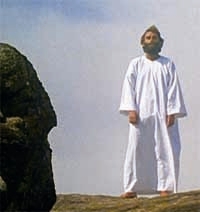 It
was by "every word that comes from the mouth of God" that Jesus
lived (Matthew 4:4). So we are to be guided by every verse and every word
of Scripture. There is power in the Word, but there is no power in self.
The strength of the Bible is ours. The psalmist says, "I have hidden
your word in my heart that I might not sin against you" (Psalm 119:11).
"By the word of your lips I have kept myself from the ways of the
violent" (Psalm 17:4).
It
was by "every word that comes from the mouth of God" that Jesus
lived (Matthew 4:4). So we are to be guided by every verse and every word
of Scripture. There is power in the Word, but there is no power in self.
The strength of the Bible is ours. The psalmist says, "I have hidden
your word in my heart that I might not sin against you" (Psalm 119:11).
"By the word of your lips I have kept myself from the ways of the
violent" (Psalm 17:4).
3. Christ was consecrated to God. He came into this world for a purpose. The prophet said, "He will not falter or be discouraged till he establishes justice on earth" (Isaiah 42:4). Even at the cost of life itself, Jesus determined to save the human race. He counted the cost and willingly accepted the pain and sacrifice demanded of Him. Although He had to tread the winepress alone, He pressed forward through the conflict, determined that He would not yield an inch to the devil.
We will never understand how much our redemption has cost until we pass through the portals of the eternal city of God and stand with our Redeemer before God's throne. Then we will know something of the great condescension and love of Jesus which led Him to leave the heavenly palaces and come to this world to live and die for us. We will cast our crowns at his feet and raise the song of praise and adoration:
"Worthy is the Lamb, who was slain, to receive power and wealth and wisdom and strength and honor and glory and praise!" (Revelation 5:12).

**********************************************************************
Original
manuscript author: Beatrice S. Neall
Editors revised edition: Barbara Shelley, Sue Robinson
Design and Layout: DEC Designs, Morisset, New South Wales Australia.
Used by permission of Discovery Centre, Wahroonga, New South Wales, Australia.
Graphics: Still images taken from Matthew video, copyright © 1997,
2004 by International Bible Society. Used by permission of International
Bible Society.
Scripture: Scripture taken from the HOLY BIBLE, NEW INTERNATIONAL VERSION
®. Copyright © 1973, 1978, 1984 by International Bible Society.
Cover Picture: "The Light of the World" by Nathan Green, ©2004
All Rights Reserved.
www.hartclassics.com
Copyright © 2007
revised edition, Voice of Prophecy, California.